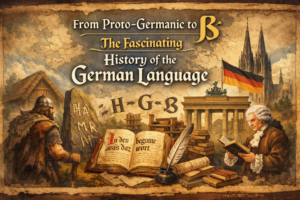
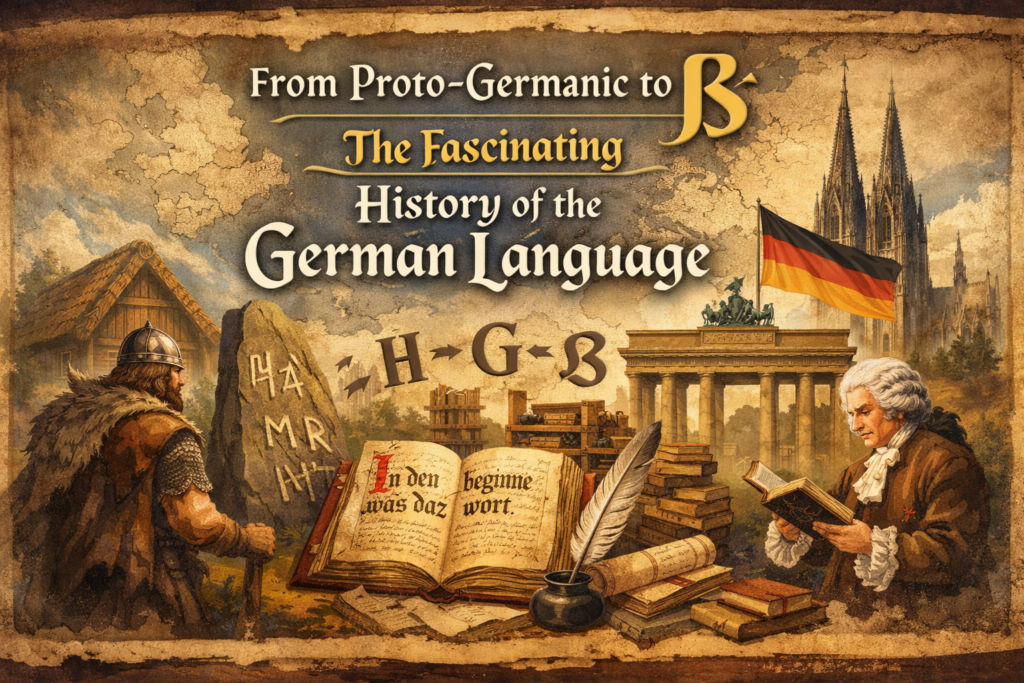
Have you ever wondered how a language spoken by ancient tribes evolved into the most widely spoken native tongue in the European Union? Today, German boasts over 100 million speakers and is famous for its intricate grammar, compound words, and logical structure.
But German wasn’t built in a day. Its journey is a thrilling, centuries-old odyssey shaped by migrations, empire-clashing history, a rogue monk, and a printing press. Let’s take a deep dive into the living tapestry of the German language—from its ancient roots to the birth of its newest capital letter, ẞ.
1. Proto-Germanic Language: A Whisper in Time (1000 – 450 BCE)
The story begins roughly 3,000 years ago. Somewhere between 1000 and 450 BCE, the First Germanic Sound Shift separated the Germanic dialects from the broader Indo-European language family.
In these early days, written records were almost non-existent. The ancient Germanic tribes communicated via spoken dialects and left behind cryptic, mysterious runes carved into stone and wood. The first real breakthrough into a written Germanic language came in the 4th century when Bishop Ulfilas translated the Bible into Gothic, giving us the first permanent record of this ancient linguistic ancestor.
2. Roman Influence: Atta unsar, þu in himinam
As the Roman Empire expanded around 55 BCE, Roman soldiers and traders stepped onto Germanic territory. This collision of cultures didn’t erase the local tongue; instead, it enriched it.
The Germanic language at the time was a massive patchwork of distinct regional dialects. However, the introduction of Latin concepts and vocabulary gave these tribes a shared linguistic upgrade, seamlessly weaving Roman terms into the Germanic tapestry.
3. Old High German: The Echoes of Migration (600 – 1050 CE)
Around 600 CE, a massive linguistic earthquake shook the region: the Second Germanic Consonant Shift. This shift completely altered how certain consonants were pronounced, effectively drawing a line between the dialects and giving rise to Old High German.
It was during this era that a very important word made its debut: “Deutsch”. Originally derived from a word meaning “of the people,” it was used to distinguish the local Germanic-speaking populations of the Franconian Empire from those who spoke Latin or Romance languages.
4. Middle High German: The Flourishing Middle Ages (1050 – 1350 CE)
The High Middle Ages brought economic booms, political shifts, and a cultural renaissance. This period gave birth to Middle High German, the language of knights, courtly love, and epic poetry.
"Herzeliebez Vrouwelin" (Beloved, dear lady)
– A famous line by the medieval poet Walther von der Vogelweide.
Great literary masterpieces like the Nibelungenlied and Tristan emerged during this time. Linguistically, this era introduced the iconic Umlaut diacritical marks (ä, ö, ü) and further vocal shifts, making the language sound much closer to the German we recognize today.
5. Early New High German: The Printing Press & Martin Luther (1350 – 1650 CE)
The 16th century was a massive turning point, driven by two major forces: Martin Luther and Johannes Gutenberg’s printing press.
- Martin Luther’s Bible: By translating the Bible into a localized German dialect, Luther didn’t just spread religion; he standardized the language. He invented new words and phrasing that people from different regions could finally all understand.
- The Printing Press: This invention allowed Luther’s Bible and other texts to be mass-produced, rapidly spreading a unified, inter-regional standard language.
- The Humanist Movement: Concurrently, the rise of Humanism brought a fresh wave of borrowed Latin words into the vocabulary, adding layers of academic sophistication.
6. A Unified Written Language: New High German Emerges
By the late 16th century, the southern and central German dialects began coalescing into what we now call New High German.
Efforts to standardize the language intensified, resulting in a unified written system. Interestingly, while the northern dialects adapted to this new standard, Dutch—which was considered a sibling dialect during the Middle Ages—split off entirely in the 16th century to become its own independent language.
7. German as a National Language (19th & 20th Centuries)
As Germany moved toward political unification in the 19th century, the need for a flawlessly standardized national language became critical.
- The Duden Era (1880): Konrad Duden published the Orthographic Dictionary, establishing a gold standard rulebook for German spelling that lasted over a century until the official spelling reform of 1996.
- Industrial & Modern Era: The Industrial Revolution flooded the language with complex technical terms. Later, the 20th century introduced heavy influences from English (Anglicisms) and fast-paced societal changes, keeping the language highly dynamic.
8. German Today: Diverse, Dynamic, and the Rise of “ẞ”
Unlike English or Spanish, German never became a global colonial language, but its internal complexity makes it uniquely powerful. Today, regional dialects still thrive, allowing local cultures to maintain their identity within the broader language.
German is still actively evolving. In fact, in 2017, the language officially welcomed a brand-new letter to its alphabet: the capital Eszett (ẞ). Prior to this, the letter ß only existed in lowercase, causing administrative headaches when writing names or passports in all caps. The introduction of ẞ proves that German is not a stagnant museum piece—it is a living, breathing entity.
Conclusion: The Living Tapestry
From the whispered runes of Proto-Germanic tribes to the digital-ready capital ẞ, the German language is a beautiful reflection of European history. Its complex grammar, shifting consonants, and rich vocabulary tell the story of a culture that values precision, depth, and adaptation. It is truly a living testament to the centuries that shaped it.