To achieve true proficiency in German, understanding what you hear is just as important as speaking. Effective communication relies heavily on your ability to process authentic dialogue, recognize regional accents, and catch colloquial nuances.
Whether you are preparing to move to a specific region or simply want to engage more deeply with German culture, sharpening your listening skills is the key to fluency. Here are 10 practical and enjoyable tips to help you master the rhythm of the German language.
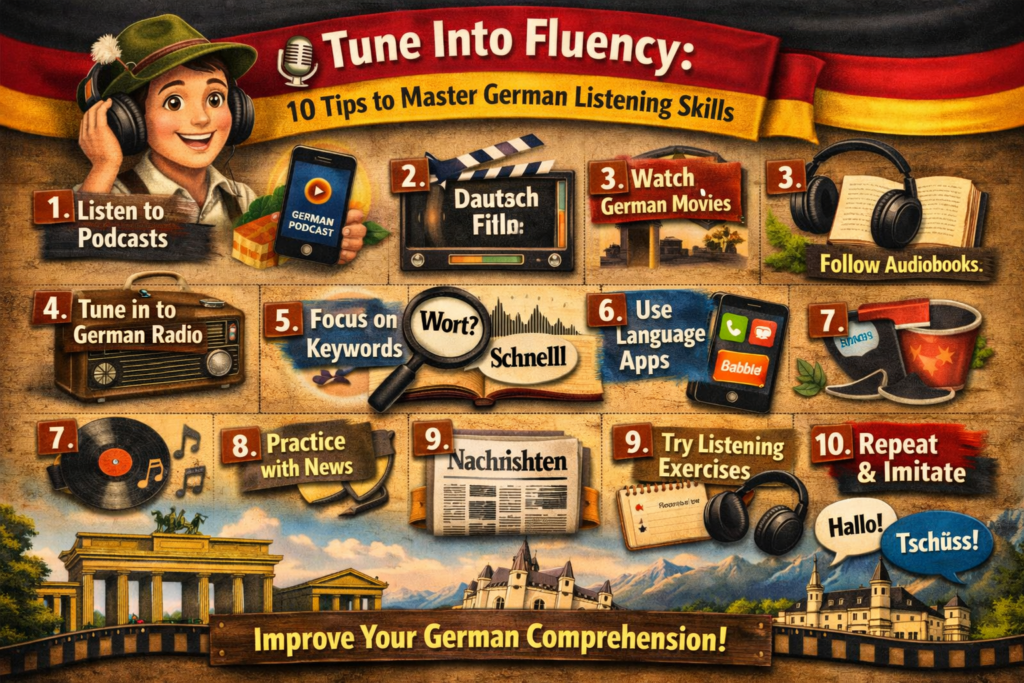
10 Tips to Improve Your German Listening
- Practice Active Listening: Don’t just let the audio play in the background. Actively focus on the words, phrases, and the speaker’s tone. Make a conscious effort to decode the meaning of what is being said.
- Consistency is Key: Set aside a specific time and place for your daily practice. Regular, consistent exposure is the most important factor in language acquisition.
- Diversify Your Content: Don’t limit yourself to one source. Experiment with podcasts, films, television series, music, and audiobooks. This exposes you to various dialects and topics.
- Use Subtitles or Transcripts: As a beginner, use content that provides both audio and text in German. This helps you bridge the gap between spelling and pronunciation. Gradually transition to German-only subtitles, and eventually, remove them entirely.
- Engage in Listening Exercises: Practice focused drills. Listen to a short clip, then try to summarize what you heard or answer specific questions about the content.
- Progressive Difficulty: Start with content that is challenging but still understandable. As you grow more confident, slowly move toward more complex material like fast-paced news or native conversations.
- Leverage Technology: Use language learning apps and platforms that offer dedicated listening drills. Many modern apps also provide feedback on your comprehension.
- Find a Language Partner: Conversing with native speakers or advanced learners is invaluable. It forces you to adapt to real-world speech patterns and varying accents.
- Take Notes: Keep a notebook nearby. Jot down unfamiliar words or expressions as you listen, then review them later to expand your vocabulary.
- Seek Feedback: If possible, ask native speakers or teachers to check your understanding. They can help identify common misconceptions and improve your grasp of tricky phrases.
4 Quick & Enjoyable Listening Exercises
If you’re looking for fun ways to practice, try these four methods:
- Watch German TV & Film: Streaming services are packed with authentic content. Use this to observe how Germans actually speak in daily life.
- Listen to Podcasts & Music: Music is great for training your ear to melody and rhythm, while podcasts—especially those on topics you enjoy—provide excellent examples of natural, organic dialogue.
- Language Exchange: Use language exchange programs to chat with native speakers. It’s a win-win: you gain listening experience in authentic scenarios, and you can help them practice their English in return.
- Targeted Apps & Websites: Use digital tools designed for learners. These are often organized by skill level (A1–C2), making it easy to track your progress systematically.
The Boundless Approach
At Boundless, we believe that mastering German is about more than just grammar; it’s about connecting with the melody of the language. Our curriculum is designed to guide you from foundational comprehension (A1) to advanced mastery (C2). By weaving authentic dialogues, diverse accents, and immersive exercises into every lesson, we help you transcend traditional boundaries.
Beyond the classroom, we encourage you to live the language by exploring German culture and media. When you combine our comprehensive training with your own daily practice, you aren’t just learning a language—you are orchestrating a profound connection to the rhythm of German life.
Ready to start? Visit our website to check out our latest listening resources and take your German skills to the next level!